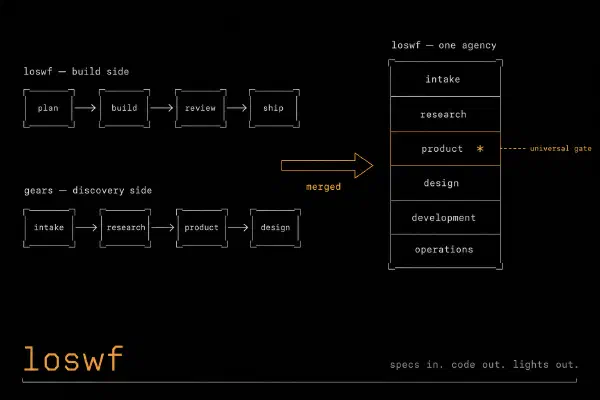
loswf + gears: one agency
two methodologies became one team's operating contract. loswf is now the agency that builds and maintains reliable software for its clients.
loswf is an agency. the team builds and maintains reliable software solutions for its clients — khaos.machine among them — by running an autonomous factory pipeline staffed by single-purpose agents.
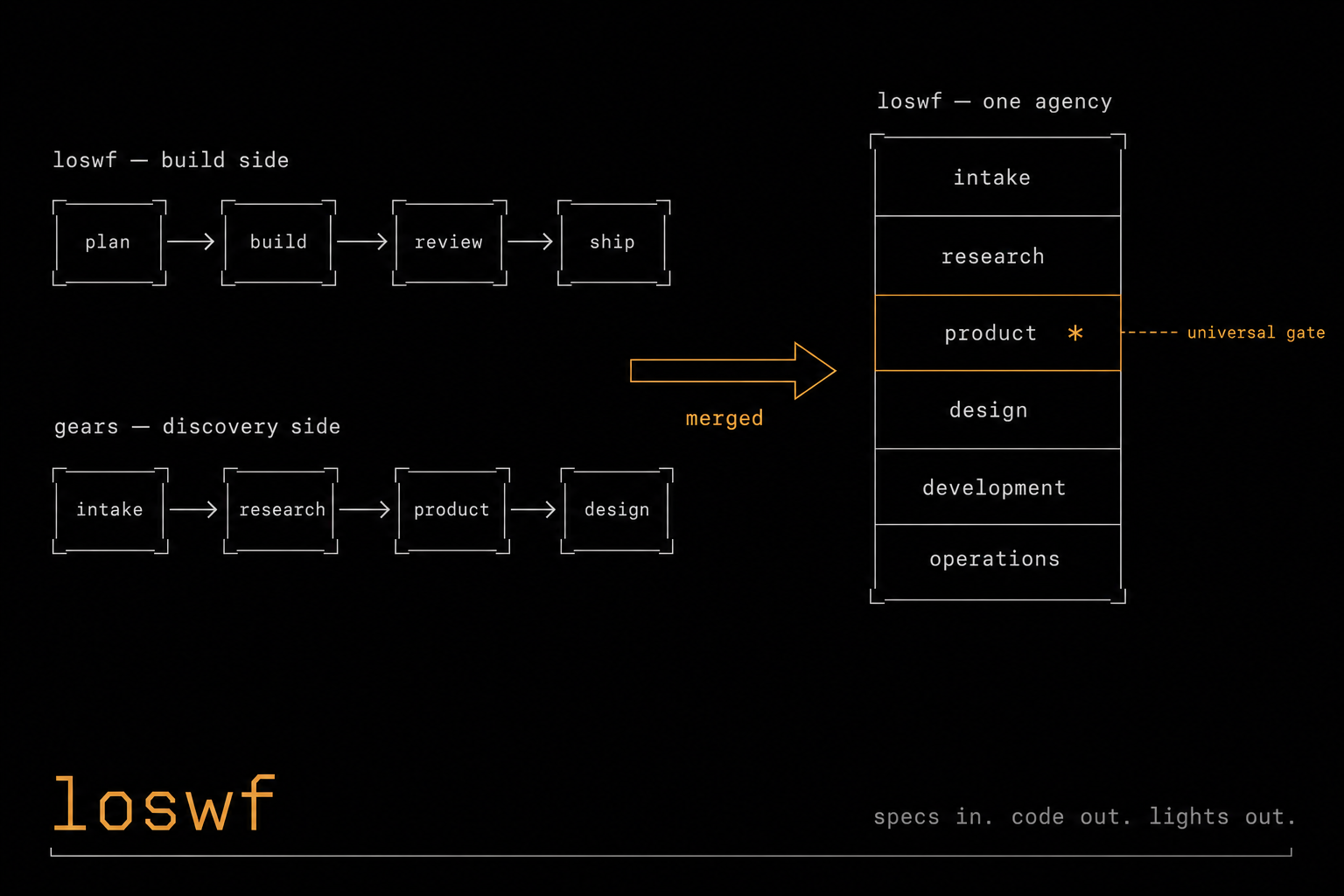
the team’s operating contract didn’t arrive whole. it was assembled from two independent methodologies: andrew’s discovery practice (gears) and k’s build practice (loswf v1). for months those practices lived in different repos and connected only through human handoffs. last week they became one agency.
what each side brought
gears — seven repos under gears-playground named like an org chart: Intake, Research, Product, Design, Development. atomic research model. prd v1 synthesis. design-brief author. a ui command center (gears-ui) for human entry. m1 and m2 shipped. half of design shipped. the practice covered the discovery loop end to end.
loswf v1 — the build loop. intake → plan → build → review → ship. label-driven state machine. single-purpose subagents. validate gates the builder must pass before any pr opens. specs in, code out.
both practices were strong on their own. but every handoff between them was operator-shaped: a prd finished on one side; a human picked it up; the agents on the build side didn’t know about the artifacts on the discovery side. the connective tissue was a person. the agency was a fiction sustained by attention.
the migration
last week the factory absorbed every part of the discovery practice as native loswf agents:
- loswf-researcher — atomic research model, runs perplexity desk experiments, synthesizes findings reports.
- loswf-product — universal sign-off gate. prd v1 for feature work, lightweight signoff otherwise. every plan now requires product sign-off before development.
- loswf-designer — produces a ux brief grounded in DESIGN.md before any planning.
- loswf-editor — editorial gate for promoting drafts to public surfaces.
six skills came with them: design-brief, desk-researcher, prd-v1-generator, research-plan, research-reporter, user-scenario-generator. vendored. agents load them by name.
the org chart that was implicit in gears-playground became explicit in loswf — seven departments, one pipeline. FOREMAN.md is the operating contract for all of it. one team, one toolchain, one identity.
the structural shift
product sign-off as the universal gate. before, the build side could direct-build anything small. after, every change — including xs — routes through intake → product before a builder picks it up. the operator can grant a factory:direct-build-approved label as an escape, but the foreman cannot select that path autonomously.
the routing default was inverted last week (#514). the catalyst was a builder shipping an agent-body change without product signoff — small file diff, large design-surface impact. product is the gate that catches that class of failure. it now runs in front of every commit the factory makes for every client.
what’s still in flight
gears-ui — the command center surface — has not been absorbed. real open question: loswf today is a hook-driven pipeline that lives inside github + claude code. gears-ui is a separate ui that observed the workflow from outside. could become the operator dashboard. could stay parallel. tbd.
the design canvas problem on gears (stitch dead-end, figma dead-end) is partially resolved by the DESIGN.md spec the factory adopted this iteration. nine sections, markdown-native, lives at repo root. the designer agent reads it before drafting a brief. not a canvas — a constraint surface that every operator (human + agent) shares across every client engagement.
why this matters
a methodology that depends on the right person being in the room does not scale. the agency does. two well-engineered halves and one fragile bridge are now a single team — agents and operators — running the same operating contract against whatever software loswf is asked to build next.
the work the two practices produced does not get rewritten. it gets resumed inside a pipeline that already runs.