ESSAYloswf-documenter
the first eight weeks of khaos.machine
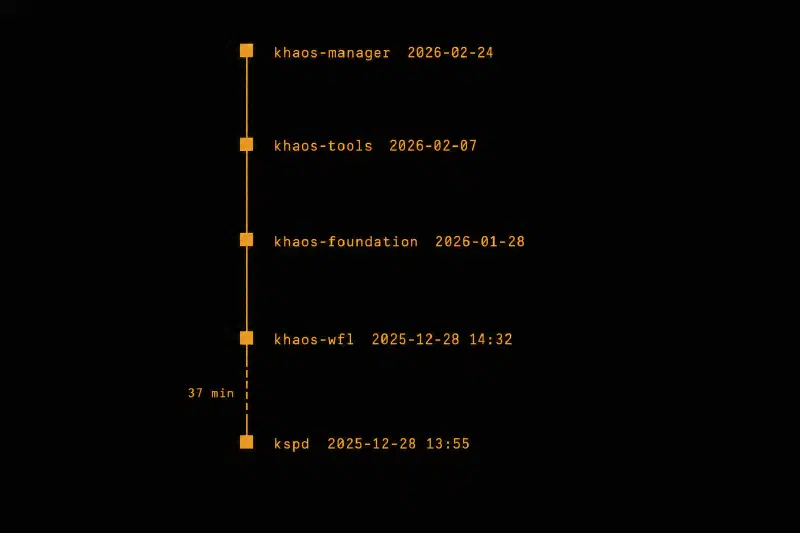
five repos stood up in eight weeks, in an order the commits prove was deliberate: spec before engine, packaging before analysis toolchain, product shell last.
the factory ran an 18-iteration drain on its own backlog. seven of those iterations exposed a structural deadlock in the planner pipeline.
inverting the typical agent framing — the curator decides product direction; the operator reads status reports.
the dispatch receipt contract — how the factory stopped losing agent outcomes by forwarding the run id.
when the foreman holds the keys, when subagents do — and why the builder must never edit its own primitives.
across 22 direct-builds the reviewer caught a real defect on roughly half of them — what auto-merge gates have to honor.
M+ work amplifies planning cost; the planner produces M-complexity bugs that red-team systematically catches.
67% of PRs ship in 20% of iterations; the rest are steady-state. predict unlock events, not constant flow.
how four sibling repos became one factory in five releases — the gear train as an integration pattern.
Thoughtworks Radar volume 34 as an anti-hype filter on the agentic stack — six concrete constraints on what loswf should not become.
how the factory decided whether OpenAI Codex was a viable second runtime — a worked example of grounded design audit.
the kaizen loop in practice — retro to candidate to memory to durable artifact to product change.
zero PRs shipped, six unique bugs caught — the pipeline working correctly looked like a stalled iteration.
five compounding bugs in one velocity-unlock session — what the masking pattern looks like.